-
Su Houng Lee (Yonsei University)9/29/22, 9:00 AM
-
Su Houng Lee (Yonsei University)9/29/22, 9:10 AM
-
Akira Ohnishi (Yukawa Institute for Theoretical Physics, Kyoto University)9/29/22, 9:50 AM
-
Tetsuo Hatsuda (RIKEN)9/29/22, 11:00 AM
-
Pengfei Zhuang (Tsinghua Univ.)9/29/22, 11:30 AM
-
Zhenwei Yang (Peking Univ,)9/29/22, 2:00 PM
-
Yasuhiro Yamaguchi9/29/22, 2:30 PM
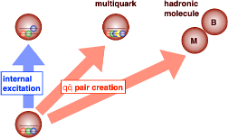
Hadrons have been understood as a quark-gluon composite state bound by the strong interactions, which is one of the interesting phenomena in the low-energy QCD. As the ordinary hadron picture, baryons and mesons are described as a three-quark state and quark-antiquark state, respectively. In fact, nucleons (protons and neutrons) can be understood as $uud$ and $udd$ baryons. However,...
Go to contribution page -
Kiyoshi Tanida (Japan Atomic Energy Agency)9/29/22, 3:00 PM
-
Avraham Gal (Hebrew University)9/29/22, 4:00 PM
-
Minjung Kwon (Inha University)9/29/22, 4:30 PM
-
Lu Meng (Ruhr Univ.)9/29/22, 5:00 PM
-
Che-Ming Ko (Texas A&M University)9/30/22, 9:00 AM
-
Jihye Song (Pusan National University)9/30/22, 9:30 AM
-
Hyung-Ok Yoon (Yonsei Univ.)9/30/22, 10:00 AM
-
Junlee Kim (Jeonbuk National University)9/30/22, 11:00 AM
-
Philipp Gubler (JAEA)9/30/22, 11:30 AM
-
Atsushi Hosaka (RCNP, Osaka University)9/30/22, 2:00 PM
-
Hongxi Xing (South China Normal University)9/30/22, 2:30 PM
-
Qian Wang (South China Normal University)9/30/22, 3:00 PM
The nature of exotic hadrons beyond the conventional quark model has being a hot topic in hadron physics. Since the observation of the first exotic charmonium-like state, i.e. the X(3872), numerous exotic candidates have been reported by various experimental collaboration. Especially, the fully charm tetra quark X(6900) and the double charm tetraquark Tcc observed in pp collision arouse...
Go to contribution page -
Ulrich Wiedner (Ruhr-University Bochum)9/30/22, 4:00 PM
-
Benjamin Doenigus (Goethe-University Frankfurt)9/30/22, 4:30 PM
-
Takayasu Sekihara (Kyoto Prefectural University)9/30/22, 5:00 PM
-
Takuya Sugiura (RIKEN)9/30/22, 5:30 PM
-
Shigehiro Yasui (Keio University)10/1/22, 9:00 AM
We discuss the interaction between an anti-$D$ meson and a nucleon in terms of the meson exchange model. We provide the interaction vertices and the non-relativistic potentials, based on the chiral symmetry and the heavy quark spin symmetry. In numerical calculations, we show several bound states below the lowest thresholds, which contain at least five quarks as the pentaquark states. We...
Go to contribution page -
Baoyi Chen (Tianjin University)10/1/22, 9:30 AM
We investigate the centrality and momentum dependence of X(3872) in heavy-ion collisions via the Langevin equation and instant coalescence model (LICM). When X(3872) is treated as a compact tetraquark state, the tetraquarks are produced via the coalescence of heavy and light quarks near the quantum chromodynamic (QCD) phase transition due to the restoration of the heavy quark potential at...
Go to contribution page -
Yorito Yamaguchi (Hiroshima University)10/1/22, 10:00 AM
-
Tetsuo Hyodo (Tokyo Metropolian U.)10/1/22, 11:00 AM
-
Yongsun Kim (Sejong University)10/1/22, 11:30 AM
-
Shung-Ichi Ando10/1/22, 12:00 PM
-
Sanghoon Lim (Pusan National University)10/1/22, 2:00 PM
-
Bunkyu Kim (SungKyunKwan Univ.)10/1/22, 2:30 PM
-
Sungtae Cho (Kangwon National University)10/1/22, 3:00 PM
-
Xu-Guang Huang (Fudan University)10/1/22, 4:00 PM
-
Ahmad Jafar Arifi (APCTP)10/1/22, 4:30 PM
-
Takuya Sugiura
-
Lata Thakur (APCTP)
Choose timezone
Your profile timezone: